
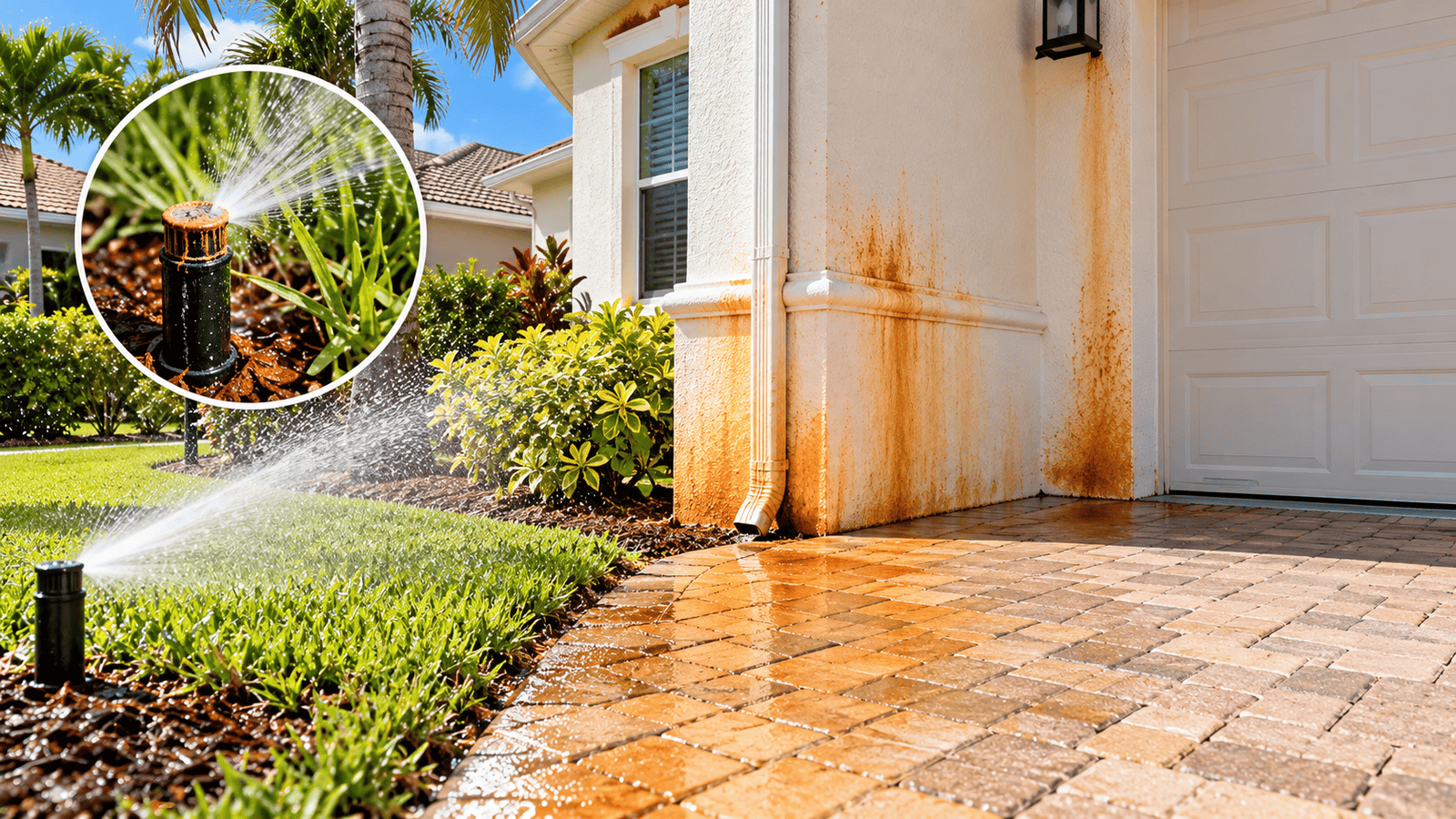
Why Florida Sprinklers Leave Orange Rust Stains on Houses and Driveways — And How to Remove Them Permanently
Florida sprinklers leave orange rust stains because the irrigation water contains dissolved iron that oxidizes the moment it hits open air. The iron stays invisible underground, clear, liquid, and dissolved, but the second it sprays through a sprinkler nozzle and contacts oxygen, it converts to solid iron oxide. That iron oxide settles into the microscopic pores of concrete, stucco, brick, and vinyl and bonds to the surface at a chemical level. Plain water, soap, and standard pressure washing cannot dissolve iron oxide. That is why the stains look permanent, because chemically they are, until you use the right treatment.
Here’s everything you need to know about why this happens in Florida specifically, why it’s worse here than almost anywhere else, and what actually removes it versus what wastes your time.
The Short Answer — Why Your Sprinklers Are Staining Everything
| Factor | What Happens |
|---|---|
| Iron-rich Florida groundwater | Dissolved ferrous iron enters irrigation system from shallow aquifer |
| Sprinkler nozzle aerates the water | Iron contacts oxygen and converts to solid iron oxide (rust) |
| Porous surfaces absorb the rust particles | Concrete, stucco, brick, and vinyl trap iron oxide in microscopic pores |
| Daily irrigation cycle repeats | Layer after layer of iron oxide deposits and bonds deeper into the surface |
| Standard cleaning can’t dissolve iron oxide | Pressure washing and bleach remove surface debris but not iron oxide bonds |
Why Florida Is Worse Than Almost Every Other State
This is the part the AI overview and most competitor articles miss, the explanation stops at “iron in the water” without explaining why Florida homeowners deal with this at a scale that most of the country never experiences.
Florida sits on the Floridan Aquifer System, one of the most productive limestone aquifer systems in the world. The aquifer draws water through iron-rich soil and rock formations before it reaches the surface. Iron concentrations in Florida groundwater vary by location but Central Florida, including St. Cloud, Kissimmee, and surrounding Osceola County, consistently tests among the highest in the state for dissolved iron content.
The EPA’s secondary drinking water standard for iron is 0.3 parts per million. Many Florida irrigation wells test significantly above that threshold. At 0.3 ppm and above iron staining on exterior surfaces becomes visible with consistent exposure. At 1.0 ppm and above, not uncommon in parts of Osceola County, the staining accumulates visibly fast and turns surfaces deep orange within a single irrigation season.
The second factor that makes Florida worse is the irrigation frequency. Most Florida homes run irrigation systems five to seven days per week during the growing season. Every cycle deposits a new microscopic layer of iron oxide on whatever surface the spray reaches. Individually those layers are invisible. Over weeks, months, and years they build up into the deep orange staining that looks like it was there when the house was built.
The third factor is surface porosity. Florida’s most common exterior surfaces, concrete driveways, stucco exteriors, brick pavers, and vinyl fencing, are all highly porous. They absorb iron oxide particles rapidly, especially in Florida’s heat where wet surfaces dry fast and the iron oxide bonds before it can be rinsed away.
Put high-iron groundwater, daily irrigation, and porous surfaces together in a hot humid climate and you have the conditions for some of the worst irrigation rust staining in the country. This is not a maintenance failure. It is a chemistry problem specific to Florida’s geology and landscape management practices.
The Surfaces Most Affected and Why
Concrete driveways and sidewalks — The most commonly stained surface in St. Cloud and surrounding communities. Concrete is extremely porous and iron oxide penetrates quickly. Staining appears as orange or reddish-brown rings and streaks radiating outward from wherever the sprinkler head is aimed. On driveways that have been stained for multiple seasons the coloring penetrates deep enough that it’s visible even when the surface is wet.
Stucco exteriors — Stucco is one of the most porous exterior finishes used on Florida homes. Iron oxide penetrates the open texture rapidly and deeply, which is why stucco rust staining often looks severe even when it’s relatively recent. Vertical stucco walls show distinctive streaks running downward from the height the irrigation spray reaches.
Brick and concrete pavers — Paver driveways and walkways are extremely common in HOA communities throughout St. Cloud, Harmony, and Hunter’s Creek. The grout lines between pavers concentrate iron oxide deposits, creating patterns of orange staining that contrast sharply against the paver surface. Paver rust staining is some of the most visually dramatic because of that contrast.
Vinyl fencing — Vinyl doesn’t absorb iron oxide the way concrete and stucco do, the surface is less porous. But the orange staining sits on the surface and becomes increasingly difficult to remove the longer it’s left. Vinyl that sits adjacent to irrigation heads accumulates a brownish-orange film that makes white or tan fencing look permanently dirty.
Pool cage aluminum framing — Aluminum pool cage frames adjacent to irrigation zones develop rust staining that combines with the frame’s own oxidation to create a particularly stubborn discoloration. The rust staining accelerates the oxidation of the aluminum coating, which means the damage compounds over time rather than just sitting on the surface.
What Doesn’t Work — And Why
This section matters because most St. Cloud homeowners try at least two or three of these before finding something that actually works.
Pressure washing alone — Pressure washing removes dirt, loose debris, and surface-level organic growth from concrete and stucco. It does not remove iron oxide. Iron oxide that has bonded chemically with concrete cannot be mechanically blasted off, the bond is molecular, not physical. You can pressure wash an iron-stained driveway at 3,000 PSI and the orange color will still be there when it dries because you haven’t changed the chemistry of what’s bonded to the surface.
Household bleach — This one is important to understand because bleach is the instinct for most exterior cleaning problems. Sodium hypochlorite, the active ingredient in bleach, kills biological growth like algae, mold, and mildew by oxidizing the organisms. Iron oxide is already oxidized. Applying an oxidizing agent to iron oxide does nothing to dissolve it and in some cases can temporarily intensify the orange color by reacting with the iron. Bleach is the wrong chemistry for rust stains.
Consumer rust removers from hardware stores — Products like Iron Out and similar consumer rust removers work adequately on fresh, surface-level rust staining on smooth surfaces. They do not penetrate concrete or stucco deeply enough to address iron oxide that has been accumulating for multiple seasons. You get surface improvement that looks good for a few weeks and then the underlying staining is still there as the surface wears back.
Scrubbing with acid-based cleaners — White vinegar, diluted muriatic acid, and similar acids will react with iron oxide to some degree but at concentrations safe for home use they lack the strength to fully dissolve deep staining in porous concrete or stucco. Muriatic acid at higher concentrations is effective but carries significant risks for surface etching and damage if not handled correctly, it’s not a DIY solution for most homeowners.
What Actually Works — The Oxalic Acid Solution
The chemistry that actually removes iron oxide staining from Florida exterior surfaces is oxalic acid. This is what professional rust removal services use and it’s the reason a professional treatment produces results that home remedies and standard pressure washing cannot match.
Oxalic acid is a naturally occurring organic acid with a specific chemical affinity for iron oxide. When oxalic acid contacts iron oxide it reacts with the iron molecules and converts them from insoluble iron oxide, the rust that’s bonded to your driveway, into iron oxalate, which is water soluble and can be rinsed away from the surface.
This is a fundamentally different process than pressure washing or scrubbing. You are not mechanically removing the iron from the surface. You are chemically converting it into something that can be removed. That’s why oxalic acid works on staining that has been there for years and that nothing else has touched.
The concentration matters. Professional-grade oxalic acid applications use concentrations calibrated to the severity of staining and the surface type. Too low and the reaction is insufficient to dissolve deep staining. Too high on sensitive surfaces like travertine or painted exteriors can cause etching or color change. This is why professional application produces dramatically better results than consumer products where concentration is diluted for general safety.
The dwell time matters. The oxalic acid solution needs sufficient contact time with the iron oxide to complete the chemical reaction. Applying and immediately rinsing produces partial results. A professional operator times the dwell based on the severity of staining and the surface porosity — lighter staining needs less time, years of accumulated iron oxide needs more.
The neutralization and rinse process matters. After the oxalic acid treatment the surface needs to be properly rinsed and in some applications neutralized to stop the chemical reaction and protect the surface. Skipping this step can leave acid residue that continues reacting with the surface after the job is done.
The Piece Nobody Else Is Telling You — Fixing the Source
Removing existing rust stains without addressing the irrigation system that caused them means you’re back in the same situation within one to two seasons. This is the part that most rust removal articles and services don’t discuss because it’s outside their scope, but it’s the most important thing a Florida homeowner can do to protect their property long-term.
Adjust your sprinkler heads. This is free and has the highest impact of anything on this list. Walk your irrigation zones while they’re running and observe exactly where each head is spraying. Any head that is reaching your home’s exterior, driveway, sidewalk, pool cage, or fence should be redirected to stay on lawn and landscaping only. Most irrigation heads have adjustable arc settings that can be changed without replacing the head. A landscaper or irrigation technician can do a full audit and adjustment for a relatively small cost that pays for itself immediately in reduced rust staining.
Install a polyphosphate injection system. A polyphosphate feeder installed on the irrigation line before the sprinkler heads treats the water with a sequestering agent that keeps dissolved iron in its liquid form as it passes through the system. The iron never oxidizes on contact with air because the polyphosphate has bound to it and prevented the oxidation reaction. This is not a filter, it doesn’t remove the iron from the water, it chemically prevents it from converting to rust when it hits air and surfaces. Installation is a one-time cost with low ongoing maintenance and it essentially eliminates iron staining from recurring.
Install an iron filtration system. A dedicated iron oxidation and filtration system upstream of the irrigation pump removes dissolved iron from the water before it ever reaches the sprinkler heads. More expensive than polyphosphate injection but more complete, it addresses the iron at the source rather than managing the reaction. For properties with very high iron content this is the most comprehensive long-term solution.
Monitor and reclean on a schedule. Even with adjusted sprinkler heads some residual iron exposure is likely for most Florida properties. Planning a professional rust removal treatment every two to three years as part of regular property maintenance is significantly less expensive than allowing staining to accumulate to the point of deep penetration.
Frequently Asked Questions
Why are my sprinkler rust stains orange and not red like regular rust?
The orange color comes from hydrated iron oxide, iron oxide combined with water molecules, which is the specific form rust takes when iron-rich water oxidizes on an exterior surface. The classic red rust color you see on metal comes from anhydrous iron oxide, rust that has dried completely. On concrete and stucco surfaces the hydrated form is what bonds to the pores and produces the characteristic orange staining Florida homeowners know well.
Will rust stains go away on their own in Florida?
No. Iron oxide bonds to porous surfaces at a molecular level and does not break down or fade significantly over time on its own. Without treatment the staining deepens as additional layers of iron oxide are deposited by each irrigation cycle. Stains that look surface-level after one season are penetrating deeper into the concrete or stucco every season they’re left untreated.
Can I prevent rust stains if I’m on city water instead of a well?
City water in Florida is treated and has significantly lower iron content than well water. Most homeowners on municipal water supplies do not experience the same level of irrigation rust staining as those on private wells. However some older municipal distribution infrastructure in Central Florida introduces minor iron content and rust staining can still occur, just at a slower rate.
How do I know if my irrigation well has high iron content?
The most reliable method is a water test, many water treatment companies in St. Cloud and Osceola County offer free iron testing for irrigation wells. Visual indicators include orange or reddish buildup around sprinkler heads themselves, orange staining that appears within weeks of a new irrigation installation, and water that has a metallic smell or faint yellow-orange tint when observed in a white container.
Is oxalic acid safe to use near pool water and landscaping?
Oxalic acid at the concentrations used for rust removal should not enter pool water directly and landscaping should be pre-wetted and rinsed after treatment. A professional operator will protect pool water and surrounding plants as part of the application process. Oxalic acid is naturally occurring, it’s found in many common plants including spinach and rhubarb, and breaks down rapidly in soil when properly rinsed.
How long does professional rust removal last in Florida?
With adjusted sprinkler heads that no longer reach the treated surfaces, results can last three to five years before retreatment is needed. Without addressing the irrigation source the staining will return within one to two irrigation seasons as new iron oxide deposits accumulate. The combination of professional treatment plus irrigation adjustment is the only approach that produces lasting results.
Get Rust Stains Removed in St. Cloud, FL
If your St. Cloud home, driveway, or pavers have orange rust staining from irrigation spray, the Baha Softwash team provides professional rust stain removal service across St. Cloud, Kissimmee, Lake Nona, and surrounding Osceola County communities. They use oxalic acid treatment calibrated to each surface type, concrete, stucco, pavers, pool cages, and vinyl fencing, and protect your landscaping and pool throughout the process. Free quotes at (407) 901-0943.
Florida’s groundwater iron problem is not going away. But with the right chemical treatment and a corrected irrigation system you can keep your property looking the way it should year-round.

Gunnar Strauss is the owner and operator of Baha Softwash LLC, a professional exterior cleaning company based in St. Cloud, Florida. With years of hands-on experience in the pressure washing and soft washing industry, Gunnar is extremely passionate about his craft and takes great pride in helping homeowners keep their properties looking their best. He specializes in roof cleaning, house washing, concrete cleaning, and paver sealing, with a strong belief in doing things the right way, never cutting corners, and always striving to improve. His passion goes beyond just cleaning— he genuinely enjoys understanding the science behind the process, tackling challenging projects, and constantly learning new ways to deliver better results. Through his blog and YouTube channel, Gunnar shares his knowledge, experiences, and love for the industry, hoping to help homeowners better understand how to care for their properties while giving others a behind-the-scenes look at the work he loves.



One Comment
Comments are closed.