
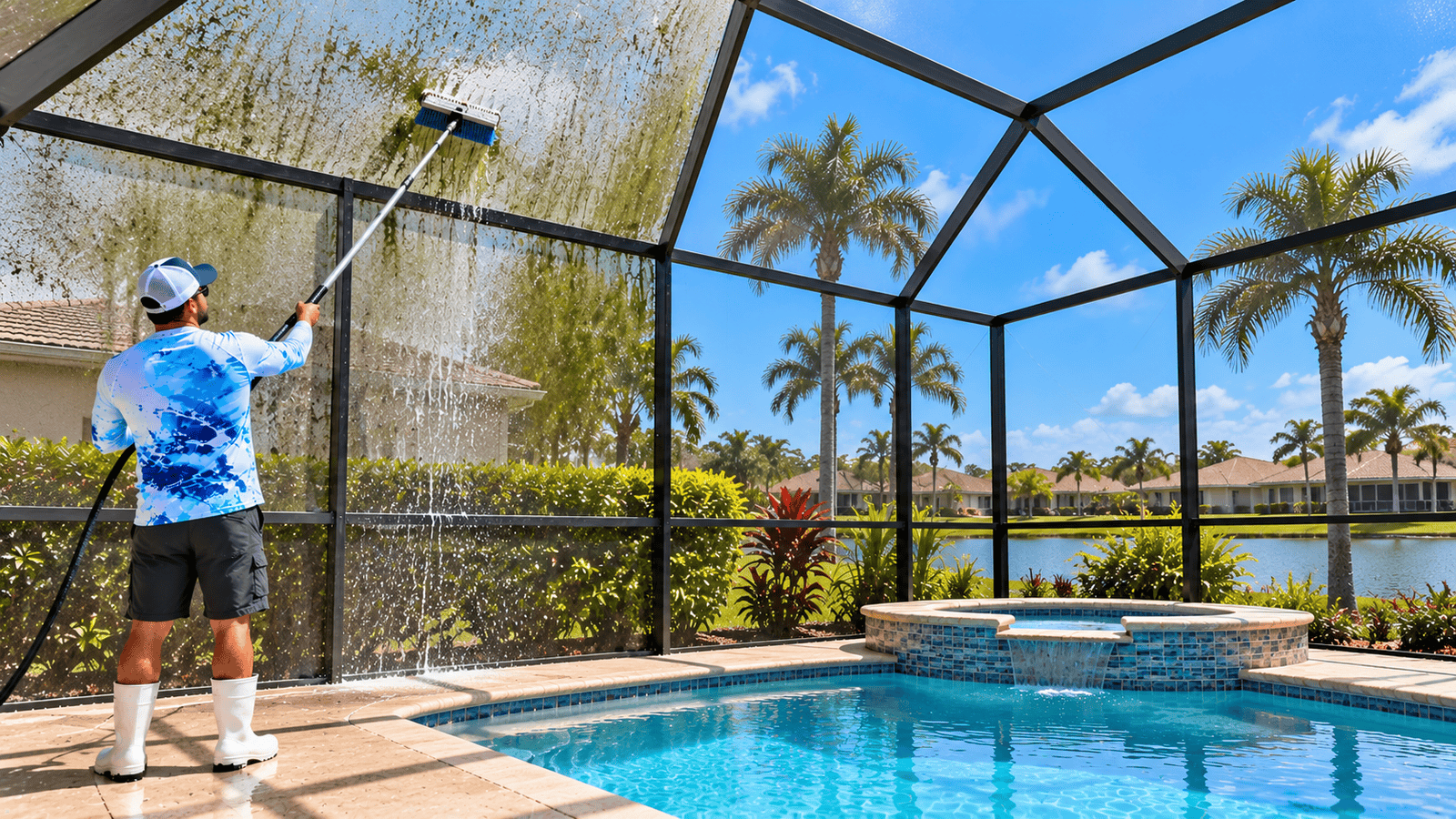
How Often Should You Clean Your Pool Cage in Florida?
Most Florida pool cages need professional cleaning once a year. Properties near retention ponds, lakes, or with heavy overhead tree canopy benefit from quarterly maintenance cleanings. The difference between those two schedules comes down to your specific property conditions — and understanding which one fits your situation saves you money over time while keeping your enclosure in better shape year-round.
Here is the full breakdown of cleaning frequency, what affects your timeline, and how to know when your enclosure needs attention right now.
How Often to Clean Your Pool Cage — Quick Reference
| Property Type | Recommended Frequency |
|---|---|
| Standard residential, open sun exposure | Once a year |
| Heavy tree canopy or shaded enclosure | Once a year minimum, consider biannual |
| Pond-adjacent or lakefront property | Quarterly maintenance |
| HOA community with strict exterior standards | Quarterly recommended |
| Vacation rental or high-use property | Biannual minimum |
Why Florida Pool Cages Need Cleaning More Often Than Other States
If you moved to St. Cloud from another state the speed at which your pool cage develops green algae and mold probably caught you off guard. Something that might take three to four years to show significant biological growth in a dry or northern climate happens in Central Florida within a single season.
Florida’s average relative humidity sits between 70 and 90 percent during summer and rarely drops below 60 percent even in January. That level of ambient moisture means screen surfaces and aluminum framing stay damp long after rain or morning dew. Algae does not need standing water to grow. It needs moisture and Florida provides it constantly.
The warm temperatures that make St. Cloud livable year-round also mean algae and mold are biologically active 12 months a year. There is no cold season to slow biological growth the way there is in Georgia, Tennessee, or anywhere north of the Florida state line. The algae establishing on your enclosure in March is still actively growing in December.
Heavy summer rainfall from June through September replenishes moisture on exterior surfaces constantly. Irrigation systems that run five to seven days a week during the growing season deposit additional moisture on and around the enclosure daily. Homes near the retention ponds and lakes throughout Harmony, Hunter’s Creek, and the waterfront communities around East Lake Tohopekaliga experience higher ambient humidity than inland properties which accelerates biological growth further.
All of this is why the cleaning schedule that makes sense for a home in Phoenix or Charlotte does not apply in St. Cloud. Florida requires a different approach and a different timeline.
To understand more about what is actually growing on your pool cage and how to remove it read our full guide on how to remove algae from a pool screen enclosure in Florida.
The Annual Cleaning — What It Covers and Why Once a Year Works for Most Properties
For most standard residential properties in St. Cloud with reasonable sun exposure and no direct pond adjacency, a professional soft wash once a year is the right schedule.
The annual deep clean kills algae, mold, and mildew at the root level using a sodium hypochlorite solution applied at low pressure with sufficient dwell time to penetrate below the surface layer of biological growth. It removes lichen buildup from the aluminum frame before it physically attaches and accelerates oxidation of the coating. It clears spider webs and organic debris that accumulate inside the enclosure throughout the year. And it resets the biological baseline before Florida’s rainy season from June through September creates the moisture conditions that accelerate regrowth.
The ideal timing for the annual clean is spring — March through May — before rainy season kicks in. Cleaning in spring means your enclosure enters the highest-growth period of the year in its cleanest state, which extends how long it stays looking good through the summer months. A fall clean in October or November is the second best option — it resets the enclosure after rainy season and going into the drier winter months.
The annual schedule is the most cost-effective approach for most St. Cloud homeowners. A single professional soft wash on a regular schedule keeps the enclosure in good condition, prevents biological growth from degrading screen fibers and aluminum coating over time, and avoids the restoration pricing that comes with heavily colonized enclosures that have been neglected for multiple seasons.
For a full breakdown of what annual pool cage cleaning costs in St. Cloud read our pool cage cleaning cost guide.
The Quarterly Maintenance Cleaning — Who Needs It and What It Involves
Quarterly cleaning is a different service from the annual deep clean. It is a lighter chemical application designed to knock back early algae growth and remove spider webs and organic debris between annual deep cleans — not a full restoration treatment.
The homeowners who benefit most from quarterly maintenance in St. Cloud are those with properties near retention ponds or lakes. Pond-adjacent homes in Harmony, Hunter’s Creek, and the waterfront communities around East Lake Tohopekaliga develop algae significantly faster than inland properties because the proximity to standing water keeps ambient humidity elevated around the enclosure year-round. Spiders are also a consistent issue for pond-adjacent homes — they establish webs inside the enclosure rapidly and the quarterly visit addresses that before it becomes a visible problem.
Quarterly cleaning works economically because each individual visit is less expensive than the annual deep clean. The lighter treatment takes less time and less chemical product because you are addressing early-stage growth before it establishes deeply rather than restoring a heavily colonized surface. Over a full year the cost of four lighter maintenance visits often approaches the cost of one heavy restoration clean — but the enclosure stays in significantly better condition throughout the year.
The recurring schedule aspect of quarterly cleaning is practical for homeowners who do not want to think about it. You set up the schedule, the crew shows up four times a year, and the enclosure stays clean without you having to evaluate whether it needs attention. Many St. Cloud homeowners near water find this approach takes the maintenance decision entirely off their plate.
To book a recurring cleaning schedule or get a quote for quarterly maintenance contact the Baha Softwash team through our pool enclosure cleaning service page.
How to Know When Your Pool Cage Needs Cleaning Right Now
Regardless of what schedule you are on the visual condition of your enclosure is the most reliable indicator of when it needs attention. Do not rely on the calendar alone.
If you can see green discoloration on the screens from inside the enclosure algae has established enough to be worth addressing. Green that is visible from inside means the biological growth has been colonizing the exterior screen surface long enough to be visually apparent — it has been there longer than it looks and the root system is already embedded in the screen fibers.
White or gray crusty buildup forming on the aluminum frame is lichen. Lichen is harder to remove than green algae because it physically attaches to the surface rather than just sitting on it. Once lichen is visible the enclosure needs attention soon — the longer lichen is left the more aggressively it attaches and the more intensive the chemical treatment required to fully remove it.
Dark mold staining on the lower frame sections and base of the enclosure is common in shaded and pond-adjacent properties. Lower sections of the frame stay damper longer than upper sections and mold establishes there first.
If screens have noticeably reduced visibility from the inside the buildup is significant. Clean screens in Florida should be largely transparent. When visibility is reduced enough to be noticeable through the screen the biological growth has been accumulating for at least a full season.
Pool water chemistry going out of balance more frequently than usual during rainy season is another indicator. Algae and mold on a dirty enclosure shed spores and organic material into the pool with every rainstorm. If your pool chemistry is harder to maintain during rainy season the condition of the enclosure is part of the equation.
What Happens If You Wait Too Long
Delaying pool cage cleaning beyond the recommended schedule creates a compounding problem that becomes progressively more expensive to address.
Light green algae that could be removed with a standard annual soft wash becomes heavy colonization when left for two or three seasons. Heavy colonization means more chemical product, longer dwell times, and sometimes multiple applications to fully kill the root system. The restoration clean that results is significantly more expensive than the maintenance clean that would have prevented it.
Screen fibers degrade faster when biological growth is left to establish long-term. Algae root systems work into the mesh fibers over time which accelerates degradation and shortens screen lifespan. A screen that should last 10 to 15 years in maintained condition may need replacement in 7 to 8 years when heavy biological growth has been present for multiple seasons. Screen replacement on a full-size Florida pool enclosure is not a small expense.
Lichen that is left on aluminum framing produces organic acids as a metabolic byproduct. Those acids accelerate breakdown of the powder coating on the frame. Once the coating is compromised oxidation progresses faster — and at that point you are looking at repainting or frame repair rather than cleaning.
The economic logic is straightforward. Consistent annual or quarterly cleaning is maintenance pricing. Waiting until the enclosure is severely colonized and the screens or frame are affected is restoration pricing. The difference is real and it gets larger the longer you wait.
Pond-Adjacent Properties in St. Cloud — Why They Need a Different Schedule
The communities around East Lake Tohopekaliga, the retention pond neighborhoods throughout Harmony, and the waterfront-adjacent areas in Hunter’s Creek consistently produce the fastest pool cage algae cycles in the St. Cloud area.
Proximity to standing water means elevated ambient humidity directly around the property even on days when the broader area is dry. That persistent moisture creates conditions where algae establishes faster and grows more aggressively than on inland properties with good sun exposure and air circulation.
Spider buildup is also distinctly worse for pond-adjacent homes. Spiders are drawn to the enclosure structure and the insects that gather near water. Without regular clearing the interior of the enclosure accumulates webs, egg sacs, and dead insects that add to the organic material feeding mold and mildew growth on the lower frame sections.
For these properties the annual schedule frequently results in enclosures that look noticeably dirty by the six-month mark. Quarterly maintenance — a lighter treatment every three months — keeps the enclosure looking clean throughout the year and prevents the heavy colonization cycles that make the annual deep clean more intensive and more expensive.
HOA Communities and Pool Cage Cleaning Compliance
If your home is in an HOA community in St. Cloud the cleaning schedule is not just about aesthetics. Hunter’s Creek, Harmony, and other active HOA communities in Osceola County regularly issue exterior maintenance violation notices that include pool cage appearance.
HOA boards inspect properties for green screens, mold-stained framing, and visibly dirty enclosures. A violation notice requires you to address the issue within a specified window and may include fines for non-compliance. Properties that get violation notices usually need cleaning on a tighter timeline than they would have chosen themselves — and rushed cleanings sometimes mean paying premium rates for availability.
The more practical approach is staying ahead of the violation cycle with a consistent cleaning schedule. Quarterly cleaning for pond-adjacent or heavily shaded HOA properties virtually eliminates the risk of exterior compliance violations. Annual cleaning for standard HOA properties keeps enclosures within acceptable appearance standards without the cost of more frequent visits.
Professional documentation of cleaning dates and before and after photos is available for HOA records if your association requires proof of maintenance.
For properties in HOA communities that need broader exterior cleaning compliance including driveways, sidewalks, and common areas read our guide on HOA pressure washing services in St. Cloud, FL.
The Best Time of Year to Schedule Pool Cage Cleaning in St. Cloud
Timing the annual clean strategically extends how long the results last.
Spring is the best time for most St. Cloud homeowners. Scheduling in March, April, or May means your enclosure enters Florida’s rainy season — June through September — in its cleanest state. Algae growth accelerates significantly during rainy season because of consistent moisture replenishment. Starting rainy season with a freshly treated enclosure means the biological baseline is reset and the growth cycle has to start from scratch rather than building on an existing colonized surface.
Fall is the second best option. Cleaning in October or November addresses the biological growth that accumulated during rainy season and resets the enclosure going into the drier winter months. For homeowners who prefer not to have service during the busy spring season a fall clean still produces a full year of results.
The timing that does not work well is summer — scheduling during peak rainy season in July or August means the enclosure is cleaned and then immediately subjected to the highest-moisture period of the year. Results still last but the timeline to visible regrowth is shorter than a spring or fall clean in the same conditions.
Frequently Asked Questions
How often should you clean a pool cage in Florida?
Once a year for most standard residential properties. Homes near retention ponds, lakes, or with heavy tree canopy benefit from quarterly maintenance cleaning because Florida’s humidity and waterfront conditions accelerate algae growth significantly faster than on inland open-exposure properties.
Is once a year enough for a Florida pool enclosure?
For most St. Cloud properties with reasonable sun exposure and no direct pond adjacency yes — annual professional soft washing is sufficient to keep the enclosure in good condition and prevent long-term screen and frame degradation. Properties near water or in heavy shade may find algae returns visibly within six months and benefit from a more frequent schedule.
How often should I clean my screen enclosure if I live near a pond?
Quarterly maintenance cleaning is the recommended schedule for pond-adjacent properties in St. Cloud. The elevated ambient humidity near standing water accelerates algae and spider buildup significantly compared to inland properties. Quarterly visits with lighter chemical treatment keep the enclosure clean year-round and prevent the heavy colonization cycles that make annual deep cleans more intensive.
What happens if I never clean my pool cage?
Algae and mold colonize the screen fibers and degrade them faster than normal, shortening screen lifespan. Lichen attaches to the aluminum frame and produces organic acids that accelerate powder coating breakdown and oxidation. Buildup compounds year over year making each subsequent clean more intensive and expensive. Eventually screen replacement and frame repainting become necessary years earlier than they would with consistent maintenance.
How much does quarterly pool cage maintenance cost?
Quarterly maintenance visits are lighter treatments than the annual deep clean and are priced accordingly. For a full breakdown of pool cage cleaning pricing in St. Cloud including single story, two story, lanai, and bundle pricing read our pool cage cleaning cost guide for St. Cloud, FL.
Can I clean my pool cage myself between professional cleanings?
A garden hose rinse from inside the enclosure pushing outward removes loose debris and early surface algae between professional visits and is worth doing monthly. For established algae growth professional-grade sodium hypochlorite concentration and proper dwell time are required to kill the root system — consumer bleach products at retail concentration are usually insufficient for anything beyond very light recent growth. Read our full guide on how to remove algae from a pool screen enclosure in Florida for the complete DIY process and its limitations.
Schedule Your Pool Cage Cleaning in St. Cloud
The Baha Softwash team handles pool enclosure cleaning in St. Cloud, FL on annual and quarterly schedules throughout St. Cloud, Kissimmee, Narcoossee, Harmony, Hunter’s Creek, and surrounding Osceola County communities. Every job includes pool and landscaping protection throughout the process and a full walkthrough on completion. Recurring maintenance schedules available for pond-adjacent and HOA properties.
Free quotes at (407) 901-0943.

Gunnar Strauss is the owner and operator of Baha Softwash LLC, a professional exterior cleaning company based in St. Cloud, Florida. With years of hands-on experience in the pressure washing and soft washing industry, Gunnar is extremely passionate about his craft and takes great pride in helping homeowners keep their properties looking their best. He specializes in roof cleaning, house washing, concrete cleaning, and paver sealing, with a strong belief in doing things the right way, never cutting corners, and always striving to improve. His passion goes beyond just cleaning— he genuinely enjoys understanding the science behind the process, tackling challenging projects, and constantly learning new ways to deliver better results. Through his blog and YouTube channel, Gunnar shares his knowledge, experiences, and love for the industry, hoping to help homeowners better understand how to care for their properties while giving others a behind-the-scenes look at the work he loves.


