
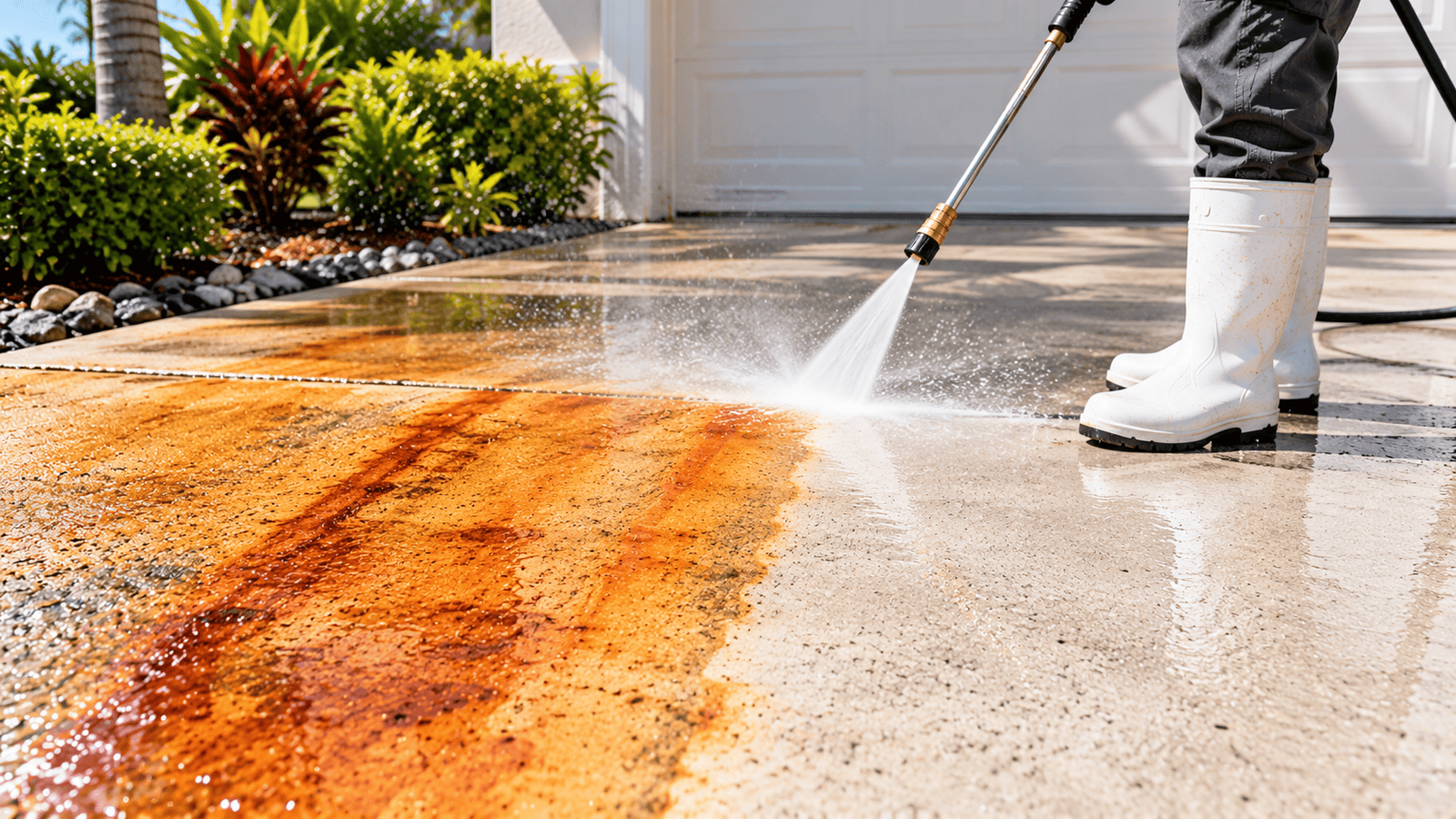
Can Pressure Washing Remove Rust Stains From Concrete?
No. Pressure washing cannot remove rust stains from concrete.
This is one of the most common misconceptions in exterior cleaning and it costs Florida homeowners time, money, and frustration every year. You rent or hire a pressure washer, blast the orange staining off your driveway, it looks better for a few days, and then the orange comes back. Sometimes it looks worse than before.
That happens because rust staining is a chemistry problem and pressure washing is a mechanical solution. You cannot solve a chemistry problem with mechanical force. Here is why that matters, what pressure washing actually does to rust-stained concrete, and what the correct approach is.
The Direct Answer by Situation
| Situation | Will Pressure Washing Remove It? | What Actually Works |
|---|---|---|
| Fresh rust stain, less than 30 days old | Partially, surface level only | Oxalic acid treatment plus rinse |
| Rust stain from irrigation, 6 months to 2 years | No | Professional-grade oxalic acid |
| Deep multi-season irrigation rust staining | No, may make it worse | Professional oxalic acid service |
| Rust stain from metal furniture or fertilizer | Surface only, temporary | Oxalic acid treatment |
| Rust on sealed concrete | No | Strip sealer, treat, reseal |
Why Pressure Washing Doesn’t Remove Rust
To understand why pressure washing fails on rust stains you need to understand what rust staining actually is at a chemical level.
Rust staining on concrete is iron oxide, solid iron oxide particles that have bonded chemically with the calcium silicate compounds inside the concrete. This bonding happens at a molecular level inside the microscopic pores of the concrete surface. Iron oxide is not sitting on top of the concrete waiting to be blasted off. It has chemically integrated into the surface material itself.
Pressure washing works by mechanically removing surface deposits through water impact force. It removes dirt, algae, mold, loose debris, and organic material because those things are physically adhered to the concrete surface without a chemical bond. When you blast them with high-pressure water the mechanical force breaks the physical adhesion and they wash away.
Iron oxide does not have a physical adhesion to the concrete surface. It has a chemical bond. No amount of mechanical force dissolves a chemical bond. You can hit iron-stained concrete with 4,000 PSI all day and the orange color will still be there when it dries because you have not changed the chemistry of what has bonded to that surface.
What pressure washing does to rust-stained concrete is remove the surface layer of loose dirt and debris sitting on top of the staining. The concrete looks cleaner and temporarily brighter because the surface contamination is gone. The rust staining underneath is completely untouched. When the surface dries the orange is still there. Sometimes it looks more visible than before the pressure wash because the surrounding concrete is now clean and the contrast is sharper.
What Happens When You Pressure Wash Rust-Stained Concrete in Florida
Florida irrigation rust staining has a specific characteristic that makes pressure washing even less effective than it would be on other types of rust. The staining accumulates in layers over years of daily irrigation exposure. Each irrigation cycle deposits a microscopic layer of iron oxide that bonds into the concrete pores. Over months and years those layers build up into the deep orange coloring that Florida homeowners know well.
When you pressure wash this type of staining you remove the outermost layer of iron oxide that has the loosest bond to the surface. The deeper layers that have been bonding longer and penetrating further into the concrete are entirely unaffected. The result looks like improvement immediately after washing and then within days the deeper staining is fully visible again as the surface dries completely.
In some cases pressure washing rust-stained concrete makes the overall situation harder to treat afterward. Here is why. The high-pressure water opens the concrete pores during washing. If iron-containing water from the wash or from irrigation runs across the opened pores during this period it can penetrate more deeply than it would have otherwise. The staining that results from this deeper penetration is harder to remove with subsequent chemical treatment than the original staining would have been.
This is the opposite of what most homeowners expect when they invest in a pressure washing service. Understanding why it happens prevents the frustration of cleaning a surface multiple times without getting the result you need.
The One Situation Where Pressure Washing Helps With Rust
There is exactly one scenario where pressure washing plays a useful role in rust stain removal from concrete and it is as a post-treatment rinse after chemical treatment, not as the primary cleaning method.
Here is how that works. You apply a professional-grade oxalic acid solution to the rust-stained concrete and allow it to dwell long enough for the chemistry to dissolve the iron oxide bonds. Once that chemical reaction is complete and the iron oxide has been converted to water-soluble iron oxalate, the surface needs to be thoroughly rinsed to remove the dissolved material and chemical residue.
A rotary surface cleaner attachment on a pressure washer used at this stage is an efficient way to flush the treated surface completely. The chemistry has already done the work of dissolving the rust. The surface cleaner is just removing the dissolved material and rinsing the concrete evenly.
This is completely different from using pressure washing as the rust removal method. The sequence matters. Chemistry first. Pressure as a rinse tool after the chemistry has worked. Reversing that sequence produces the results most homeowners experience when they try pressure washing alone.
What Actually Removes Rust Stains From Concrete
The chemistry that dissolves iron oxide is oxalic acid. This is what professional rust removal services use and it is the reason a proper treatment produces results that pressure washing cannot.
Oxalic acid reacts with iron oxide molecules and converts them from insoluble iron oxide into iron oxalate which is water soluble. Once the iron oxide has been converted to iron oxalate it can be rinsed out of the concrete pores. The staining is gone not because it was mechanically removed but because it was chemically converted into something that can be rinsed away.
This is why oxalic acid works on staining that has been there for years and that nothing else has touched. It is addressing the chemistry of the staining rather than the surface appearance.
The factors that determine whether DIY oxalic acid treatment works or whether professional service is needed:
Stain age and depth. Light recent staining responds well to consumer oxalic acid products at retail concentrations. Deep multi-season iron oxide staining that has been accumulating from daily Florida irrigation exposure for two, three, or five years has penetrated concrete at a depth that frequently requires professional-grade concentrations and calibrated dwell times to fully address. Consumer products at diluted concentrations improve the surface appearance without fully dissolving the deeper staining.
Concrete condition. Older concrete with significant weathering and large pore structure absorbs iron oxide more deeply than newer concrete. The same staining on a 5-year-old driveway and a 25-year-old driveway requires different treatment approaches because the depth of penetration is different.
Sealed versus unsealed concrete. If the concrete has a sealer on it the oxalic acid treatment cannot penetrate to the iron oxide underneath without first stripping the sealer. Attempting to treat rust staining on sealed concrete with oxalic acid produces minimal results because the chemistry cannot reach what it needs to react with.
Surface type. Poured concrete driveways and sidewalks are the most straightforward to treat. Brick and concrete pavers require more careful technique because of the joints, the individual paver surfaces, and the need to restore the jointing sand after cleaning. Textured or exposed aggregate concrete requires extended dwell and thorough agitation to get the chemistry into the textured surface.
Step-by-Step for DIY Rust Stain Removal on Concrete
For light to moderate staining on standard concrete that you want to address yourself, here is the correct sequence.
Sweep the area completely clean of dirt and debris. The oxalic acid needs direct contact with the iron oxide staining not a layer of surface contamination.
Wet down all surrounding landscaping, grass, and plants thoroughly with plain water. Oxalic acid at treatment concentration will damage dry plants in the splash zone. A saturated plant tolerates diluted chemical exposure significantly better.
Apply the oxalic acid solution evenly across the stained area. Consumer products like Rid O’ Rust or F9 Barc work well for light staining. Keep the treated area damp throughout the dwell period. In Florida’s heat the solution can dry and stop reacting quickly in direct sun. Mist lightly with water if you see it starting to crust.
Allow sufficient dwell time. Light staining needs 5 to 10 minutes. Moderate staining needs 15 to 25 minutes. Heavy staining needs 30 to 45 minutes or longer. The staining will visibly lighten as the chemistry works. If you are not seeing any color change after 10 minutes on heavy staining your concentration is likely insufficient.
Agitate stubborn areas with a stiff nylon bristle brush. Do not use metal or wire brushes which deposit iron particles that create new rust staining.
Rinse completely with a garden hose. Flush all chemical residue from the surface and rinse surrounding landscaping again after you finish the concrete.
Evaluate when fully dry and repeat if needed. Deep multi-season staining frequently requires multiple applications.
For the full detailed guide on this process read our article on how to remove irrigation rust stains from concrete.
Why Bleach Also Fails on Rust Stains
This comes up consistently because bleach is the instinct for most exterior cleaning problems and it needs to be addressed directly.
Sodium hypochlorite the active ingredient in bleach is an oxidizing agent. It kills algae, mold, and mildew by oxidizing those organisms. Iron oxide is already fully oxidized. Applying an oxidizing agent to iron oxide does nothing to dissolve it and in some applications temporarily darkens or intensifies the orange color by further reacting with iron compounds in the concrete.
Bleach works on biological growth. It does not work on iron oxide. Using bleach on rust stains is the wrong chemistry for the problem. The correct chemistry is a reducing acid like oxalic acid that converts oxidized iron back to a soluble form that can be rinsed away.
When to Call a Professional
DIY oxalic acid treatment with quality consumer products is a reasonable approach for light to moderate recent staining on standard concrete in accessible areas. Professional service produces meaningfully better results in these specific situations.
Multi-season deep staining that has been building from daily Florida irrigation exposure for two or more years has penetrated concrete at concentrations that consumer product formulations frequently cannot fully address. Professional-grade oxalic acid at higher concentrations with properly calibrated dwell times produces complete removal where consumer products produce partial improvement.
Large surface areas like full driveways and extended sidewalks are time and labor intensive to treat properly by hand. Professional equipment makes the same job faster more consistent and more thorough.
Pavers require specific technique to avoid disturbing joint sand and need re-sanding after cleaning. Professional operators who regularly work with pavers handle this correctly without creating new problems.
Stucco and vertical exterior surfaces need different application technique to keep the chemical wet on a vertical surface during dwell time. Professional operators have the surfactants and equipment to handle vertical surface rust removal effectively.
The Baha Softwash team provides professional rust stain removal service across St. Cloud, Kissimmee, Lake Nona, and surrounding Osceola County communities. They use professional-grade oxalic acid treatment calibrated to each surface type and stain severity on concrete driveways, sidewalks, pavers, stucco, and pool cage frames. Free quotes at (407) 901-0943.
Preventing Rust Stains From Returning After Removal
Removing rust staining without addressing the irrigation system that caused it means retreating the same surfaces every one to two seasons. These are the steps that make the removal last.
Redirect the irrigation heads that are reaching your driveway, sidewalk, or home exterior. Walk your irrigation zones while they are running and adjust any head that contacts hardscapes or exterior surfaces. This is the highest-impact free action available.
Consider a polyphosphate injection system on the irrigation line. This keeps dissolved iron in liquid form as it passes through the system preventing it from converting to rust when it contacts air and surfaces. One installation eliminates new iron oxide deposition on exterior surfaces.
Seal the concrete after cleaning. A penetrating concrete sealer applied after rust removal fills the microscopic pores that iron oxide embeds into. Future iron oxide deposits sit more on the surface rather than penetrating deeply making future cleanings faster and more complete.
For the full explanation of why Florida irrigation systems create this problem and how to fix it at the source read our guide on why Florida sprinklers leave orange rust stains on houses and driveways.
Frequently Asked Questions
Can a high-powered pressure washer remove rust from concrete?
No. Even at 4,000 PSI or above pressure washing cannot remove iron oxide that has chemically bonded with concrete. The mechanical force of pressure washing removes physically adhered surface deposits. Iron oxide forms a chemical bond with the calcium silicate in concrete that mechanical force cannot dissolve. Oxalic acid is required.
What PSI do you need to remove rust from concrete?
PSI is not the relevant variable for rust stain removal. This is the fundamental misunderstanding that leads homeowners to try progressively higher-pressure equipment without results. The chemistry of oxalic acid reacting with iron oxide is what removes rust staining. No PSI setting changes this.
Does WD-40 remove rust stains from concrete?
WD-40 is a petroleum-based lubricant. It has no chemical affinity for iron oxide and will not dissolve rust staining on concrete. It will leave an oil residue on the concrete surface that attracts dirt. This is not an effective approach for rust stain removal.
How long do rust stains stay on concrete if untreated?
Permanently in practical terms. Iron oxide bonded to concrete does not break down or fade significantly over time without chemical treatment. The staining deepens as additional layers accumulate from each irrigation cycle. Staining that looks surface-level at 6 months is penetrating significantly deeper at 3 years and becomes progressively harder to fully remove with each passing season.
Is oxalic acid safe for pets and children after it dries on concrete?
Once the oxalic acid treatment has been thoroughly rinsed and the concrete surface is fully dry the treated area is safe. The chemical reaction is complete and the oxalic acid has been neutralized and rinsed away. Do not allow pets or children in the treatment area during application or before thorough rinsing is complete.
Can I use a pressure washer to rinse after oxalic acid treatment?
Yes and this is actually the recommended approach for large areas. After the oxalic acid has fully dwelled and converted the iron oxide the surface needs a thorough rinse to remove dissolved material and chemical residue. A rotary surface cleaner attachment at moderate pressure is an efficient way to flush the treated concrete completely. The sequence is chemistry first then pressure as a rinse tool not pressure as the primary removal method.

Gunnar Strauss is the owner and operator of Baha Softwash LLC, a professional exterior cleaning company based in St. Cloud, Florida. With years of hands-on experience in the pressure washing and soft washing industry, Gunnar is extremely passionate about his craft and takes great pride in helping homeowners keep their properties looking their best. He specializes in roof cleaning, house washing, concrete cleaning, and paver sealing, with a strong belief in doing things the right way, never cutting corners, and always striving to improve. His passion goes beyond just cleaning— he genuinely enjoys understanding the science behind the process, tackling challenging projects, and constantly learning new ways to deliver better results. Through his blog and YouTube channel, Gunnar shares his knowledge, experiences, and love for the industry, hoping to help homeowners better understand how to care for their properties while giving others a behind-the-scenes look at the work he loves.


One Comment
Comments are closed.