
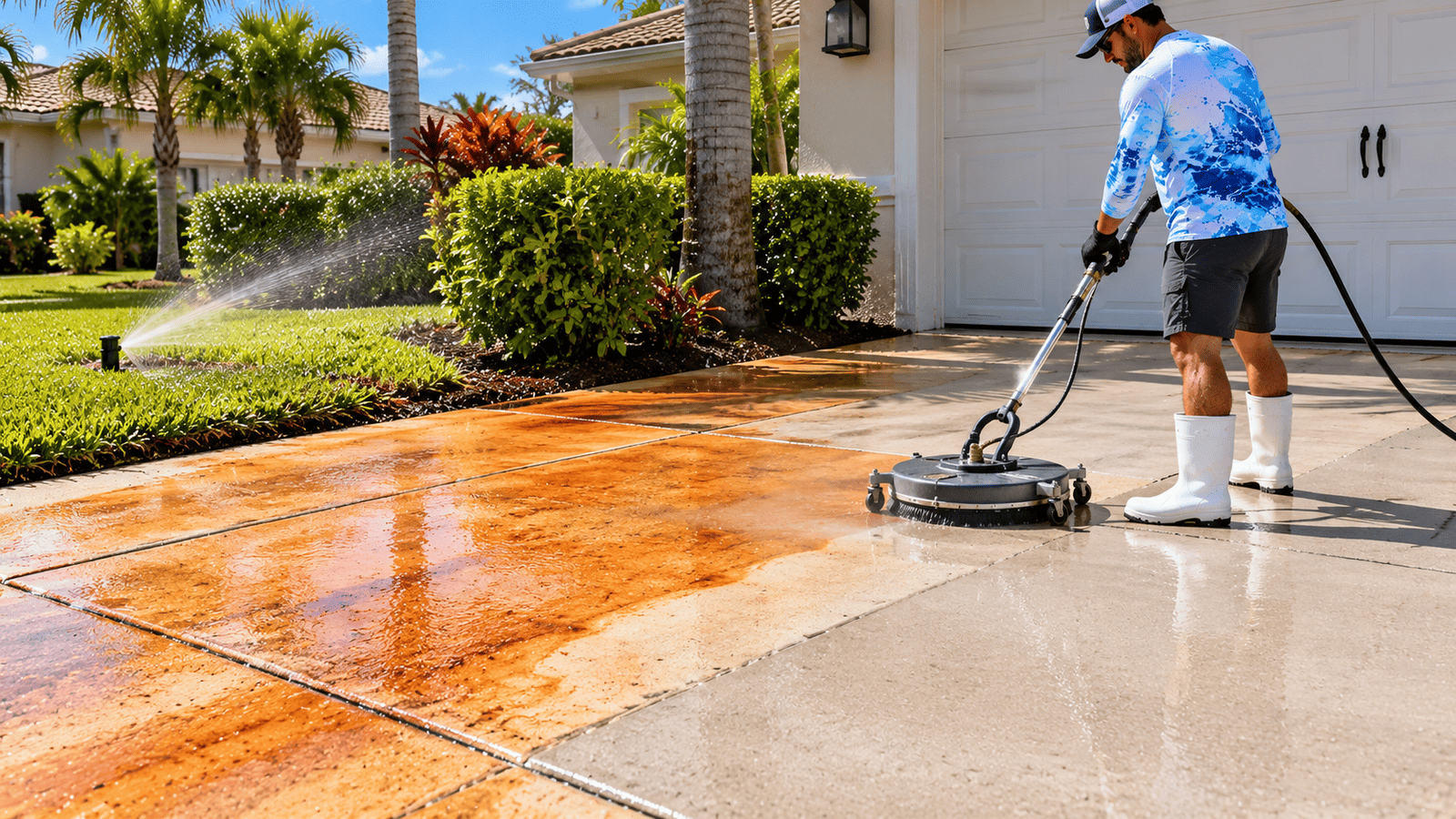
How to Remove Irrigation Rust Stains From Concrete in Florida — Step-by-Step Guide
Irrigation rust stains on concrete are one of the most common and most misunderstood exterior cleaning problems in Florida. They look permanent. They resist pressure washing. Bleach makes them worse. And the orange color keeps coming back even after you think you’ve cleaned them because the source — your irrigation system — is still depositing iron oxide on the same surface every morning.
This guide covers the exact step-by-step process for removing irrigation rust stains from concrete, what chemistry actually works and why, what the AI overview and most articles get wrong about this problem, and how to prevent the staining from coming back as fast once you’ve removed it.
If you want to understand why Florida irrigation systems cause this problem in the first place — the iron-rich aquifer, the oxidation chemistry, why Florida is worse than most states — read our full guide on why Florida sprinklers leave orange rust stains on houses and driveways first. This article focuses specifically on concrete removal.
Quick Reference — Rust Stain Removal by Stain Severity
| Stain Severity | How Long It’s Been There | Recommended Method |
|---|---|---|
| Light surface staining | Less than 6 months | Consumer oxalic acid product, single application |
| Moderate staining | 6 months to 2 years | Professional-grade oxalic acid, extended dwell |
| Heavy deep staining | 2 to 5 years | Professional oxalic acid, multiple applications |
| Severe embedded staining | 5+ years | Professional service recommended |
The older and deeper the staining the more difficult and time-consuming the removal process. This is why addressing irrigation rust staining early matters, what takes one application at 6 months may take three applications at five years and still not fully restore the original concrete color.
What the AI Overview Gets Right and What It Misses
The AI overview recommends products like Rid O’ Rust, Goof Off RustAid, and Super Iron Out. These are legitimate products that contain the right active chemistry — oxalic acid or sodium hydrosulfite — and they work adequately on fresh surface-level rust staining on smooth concrete.
Here is what that overview doesn’t tell you:
Consumer product concentrations are diluted for safety. The oxalic acid concentration in retail rust removers is significantly lower than professional-grade formulations. For light recent staining on smooth concrete they work. For the deep multi-season iron oxide staining that accumulates on Florida driveways and sidewalks from daily irrigation exposure they are frequently insufficient to fully dissolve the embedded staining. You’ll get surface improvement and the deeper coloring will still be there.
Dwell time is the variable most people get wrong. The AI overview says let it sit 5 to 10 minutes. For fresh light staining on smooth concrete that’s fine. For deep Florida irrigation rust staining that has been accumulating for years — 5 to 10 minutes is not enough dwell time for the chemical reaction to penetrate to the depth of the staining. Professional operators calibrate dwell time to stain severity. Light staining gets shorter dwell. Years of accumulated iron oxide gets significantly longer dwell and sometimes multiple applications.
Avoid pressure washing as your primary rinse is correct but incomplete. The overview correctly notes that heavy pressure washing can push iron particles deeper. What it doesn’t explain is that post-treatment surface cleaning with a rotary surface cleaner — after the oxalic acid has fully reacted — is actually beneficial and different from using pressure washing as the primary removal method. The chemical does the dissolution work. A surface cleaner removes the dissolved material efficiently.
The staining will come back without addressing the source. The overview mentions adjusting sprinkler heads as a prevention tip but treats it as optional. It isn’t optional. Removing rust staining without redirecting the irrigation heads that caused it means you’re on a one to two year cycle of retreatment indefinitely. Fixing the source is the only way to make the removal last.
What You Need Before You Start
For DIY light to moderate staining:
- Oxalic acid-based rust remover (Rid O’ Rust Liquid, F9 Barc, or equivalent)
- Stiff nylon bristle brush or drill brush attachment
- Garden hose with good water pressure
- Safety glasses and chemical-resistant gloves
- Plastic sheeting or wet towels to protect adjacent landscaping
For professional-grade removal:
- Professional-grade oxalic acid solution at appropriate concentration
- Low-pressure application pump or chemical sprayer
- Rotary surface cleaner for post-treatment cleaning
- Neutralizing rinse solution
- Full PPE — chemical gloves, safety glasses, respirator for enclosed areas
Know your concrete before you start:
| Concrete Type | Special Considerations |
|---|---|
| Standard gray concrete | Most tolerant of oxalic acid treatment |
| Colored/stamped concrete | Test in hidden area first — acid can affect integral color |
| Sealed concrete | Existing sealer may need to be stripped for treatment to penetrate |
| Older concrete (20+ years) | More porous, absorbs staining deeper, may need multiple treatments |
| Pavers (brick or concrete) | Treat individual pavers, protect grout lines, re-sand after cleaning |
Step-by-Step — How to Remove Irrigation Rust Stains From Concrete
Step 1 — Sweep and assess the stained area
Remove all loose dirt, debris, and organic material from the stained area first. You want the concrete surface clean so the rust remover makes direct contact with the iron oxide staining rather than working through a layer of surface contamination.
Assess the stain severity honestly. Light staining — faint orange tint that’s been there less than a year — is a different job than deep reddish-orange concrete that has been accumulating iron oxide for multiple irrigation seasons. Your assessment determines the concentration and dwell time you need.
Step 2 — Wet down all surrounding landscaping and adjacent surfaces
Before any chemical application thoroughly soak all grass, plants, and landscaping within splash distance with plain water. This is not optional. Oxalic acid at cleaning concentrations will damage or kill plants if they receive chemical runoff when dry. A saturated plant has a much higher tolerance for diluted chemical exposure than a dry one.
Also wet down any adjacent surfaces — sidewalks, curbs, planters — that you don’t want stained or etched by chemical runoff.
Step 3 — Test in a small hidden area first
This step matters most for colored concrete, stamped concrete, or any surface where you’re uncertain about the current finish. Apply a small amount of your rust remover to a hidden corner — under a vehicle, behind a planter, along the garage wall — and observe the reaction for 5 minutes before treating the full area.
Standard gray concrete is very tolerant of oxalic acid treatment. Colored and stamped concrete can react differently depending on the pigments and sealers used. Find out on a small hidden patch before you find out on your entire driveway.
Step 4 — Apply the rust remover to the stained area
Apply the oxalic acid solution evenly across the stained concrete. For liquid products use a pump sprayer or pour directly and spread with a brush. For powder products like Super Iron Out mix according to directions and apply as a slurry.
Keep the treated area damp throughout the dwell period. If the solution starts to dry and crust before the reaction is complete — common in Florida’s heat and direct sun — mist lightly with water to keep it active. A dried-out rust remover stops reacting.
Dwell time by stain severity:
| Stain Level | Dwell Time |
|---|---|
| Light surface staining | 5 – 10 minutes |
| Moderate staining | 15 – 25 minutes |
| Heavy multi-season staining | 30 – 45 minutes |
| Severe embedded staining | 45 – 60 minutes, may need repeat application |
You will see the chemistry working. The orange staining will begin to lighten or shift color as the oxalic acid converts iron oxide to soluble iron oxalate. This color change tells you the reaction is happening. If you’re not seeing any change after 10 minutes on heavy staining your concentration may be insufficient and a stronger application is needed.
Step 5 — Agitate stubborn areas with a brush
On heavy staining or textured concrete surfaces use a stiff nylon bristle brush or a drill brush attachment to work the solution into the concrete after it has dwelled. The mechanical agitation helps drive the chemical deeper into the pores where iron oxide is embedded.
Do not use wire or metal brushes — they introduce iron particles from the brush into the concrete which will rust and create new staining. Nylon or polypropylene bristles only.
Step 6 — Rinse thoroughly
Rinse the treated area completely with a garden hose starting from the edges and working toward the center, then reverse to flush everything off. The goal is to completely remove the dissolved iron oxalate compounds and all chemical residue from the concrete surface before they dry back down.
For large areas a rotary surface cleaner attachment on a pressure washer used after the full chemical dwell is an efficient way to flush the treated surface — this is different from using pressure washing as the primary removal method. The chemistry has already done the dissolution work. The surface cleaner is just removing the dissolved material efficiently.
Rinse the surrounding landscaping and grass again after you finish the concrete. Give everything a final flush to dilute and remove any chemical that reached plant material during the process.
Step 7 — Evaluate and repeat if needed
Once the concrete is fully dry — wait at least 2 hours in Florida’s heat — evaluate the result. Light to moderate staining treated promptly should be fully or near-fully removed in a single application. Heavy multi-season staining may show significant improvement but still have residual coloring in the deepest pore layers.
For stubborn remaining staining repeat the process. Allow the concrete to fully dry between applications so you can accurately assess what remains. On severe embedded staining three or more applications may be needed to fully restore the concrete — this is normal for staining that has been accumulating for five or more years.
Step 8 — Consider sealing the concrete after cleaning
Once the concrete is fully clean and dry — allow 48 to 72 hours minimum in Florida’s humidity — sealing the surface significantly reduces iron oxide penetration from future irrigation exposure. A penetrating concrete sealer fills the microscopic pores that iron oxide particles embed into. The sealer doesn’t prevent all rust staining but it dramatically slows accumulation and makes future cleanings faster and easier because the iron oxide sits more on the surface rather than penetrating deeply.
This is especially worth considering for driveways and sidewalks with high irrigation exposure. The sealing cost is a fraction of the professional rust removal cost and extends the time between necessary treatments significantly.
When to Call a Professional
DIY rust removal works well for light to moderate staining on standard concrete treated promptly. There are situations where professional service produces meaningfully better results and is worth the cost.
Multi-season deep staining. Iron oxide that has been accumulating for three or more years has penetrated concrete at a depth and concentration that consumer product concentrations frequently can’t fully address. Professional-grade oxalic acid formulations at higher concentrations with calibrated dwell times produce complete removal where consumer products produce partial improvement.
Large areas. Treating a 400 square foot driveway with hand-applied consumer products is a significant time and physical effort investment. Professional equipment, large-volume chemical applicators and rotary surface cleaners, makes the same job faster, more consistent, and more thorough.
Pavers. Brick and concrete paver driveways and walkways require more careful treatment than poured concrete because of the grout lines, the individual paver surfaces, and the need to re-sand joints after cleaning. Professional operators who work with pavers regularly know how to treat the staining without disturbing the joint sand and how to restore the jointing after the cleaning.
Stucco and painted surfaces. Rust staining on stucco exteriors requires a different application approach than horizontal concrete, the solution needs to stay wet on a vertical surface during dwell time which requires surfactant and technique. Professional operators have the equipment and experience to handle vertical surface rust removal efficiently.
The Baha Softwash team provides professional rust stain removal service across St. Cloud, Kissimmee, Lake Nona, and surrounding Osceola County communities, treating concrete driveways, sidewalks, pavers, stucco exteriors, and pool cage frames using professional-grade oxalic acid treatment calibrated to each surface type and stain severity. Free quotes at (407) 901-0943.
Preventing Irrigation Rust Stains From Coming Back
Removing existing staining without fixing the source means you’re retreating the same surfaces every one to two years. These are the prevention steps that actually make a difference.
Redirect irrigation heads immediately. This is the highest-impact zero-cost action available. Walk your irrigation zones while they’re running and identify every head that reaches your driveway, sidewalk, home exterior, or fence. Adjust the arc settings on those heads to keep spray on the lawn and landscaping only. Most heads have adjustment screws that change the arc and distance without requiring replacement.
Install a polyphosphate injection system. A polyphosphate feeder on the irrigation line before the heads treats the water with a sequestering agent that keeps dissolved iron liquid as it passes through the system. The iron never converts to rust because the polyphosphate has bound to it. This is a one-time installation cost with minimal ongoing maintenance that essentially eliminates new iron oxide deposition on exterior surfaces.
Test your irrigation water for iron content. Water treatment companies throughout Osceola County offer free iron testing for irrigation wells. Knowing your actual iron concentration tells you how aggressive your prevention strategy needs to be. Properties with iron above 1.0 ppm benefit significantly from filtration or injection systems. Properties just above the 0.3 ppm threshold may be adequately managed with head adjustment alone.
Seal the concrete after cleaning. As noted in the removal steps — sealing clean concrete after treatment dramatically slows iron oxide penetration from future irrigation exposure and extends the time between necessary cleaning treatments.
Frequently Asked Questions
Does vinegar remove irrigation rust stains from concrete?
White vinegar contains acetic acid which will react with iron oxide to some degree. For very light recent rust staining on smooth concrete it can produce minor improvement. For the deep multi-season iron oxide staining that accumulates on Florida driveways from daily irrigation exposure it is far too diluted to produce meaningful results. Oxalic acid is the correct chemistry for iron oxide removal.
Will bleach remove rust stains from concrete?
No — and bleach can temporarily intensify the orange color by reacting with the iron. Sodium hypochlorite is an oxidizing agent. Iron oxide is already fully oxidized. Applying an oxidizing agent to iron oxide does nothing useful and can make the staining appear darker immediately after application. Never use bleach on rust stains.
How long does it take for oxalic acid to remove rust from concrete?
Dwell time depends on stain severity — light staining responds in 5 to 10 minutes, heavy multi-season staining may need 45 to 60 minutes with possible repeat applications. The concrete must be kept damp throughout the dwell period in Florida’s heat to keep the chemical reaction active.
Can sealed concrete still get rust stains from irrigation?
Yes but significantly less severely and more slowly. A quality penetrating sealer fills the microscopic pores that iron oxide embeds into, reducing absorption dramatically. Sealed concrete that receives irrigation rust exposure tends to accumulate surface-level staining rather than deep embedded staining making future cleaning faster and easier.
Is it worth hiring a professional for concrete rust stain removal?
For light to moderate recent staining on small areas DIY with quality consumer products is reasonable. For large areas, multi-season deep staining, paver driveways, or stucco exteriors professional service consistently produces better results and is worth the cost. Professional-grade oxalic acid concentrations and proper equipment make a measurable difference on severe staining that consumer products can’t fully address.
How do I know if my concrete rust stain is from irrigation or something else?
Irrigation rust stains have a distinctive pattern — orange or reddish-brown rings and streaks that radiate outward from wherever the sprinkler head is aimed, often repeating in the same location on the same schedule. Other rust sources like metal furniture, fertilizer, or water from an iron pipe create staining in the shape of the source object. If your staining appears in the same spots every season in a pattern consistent with sprinkler coverage, irrigation iron is almost certainly the cause.

Gunnar Strauss is the owner and operator of Baha Softwash LLC, a professional exterior cleaning company based in St. Cloud, Florida. With years of hands-on experience in the pressure washing and soft washing industry, Gunnar is extremely passionate about his craft and takes great pride in helping homeowners keep their properties looking their best. He specializes in roof cleaning, house washing, concrete cleaning, and paver sealing, with a strong belief in doing things the right way, never cutting corners, and always striving to improve. His passion goes beyond just cleaning— he genuinely enjoys understanding the science behind the process, tackling challenging projects, and constantly learning new ways to deliver better results. Through his blog and YouTube channel, Gunnar shares his knowledge, experiences, and love for the industry, hoping to help homeowners better understand how to care for their properties while giving others a behind-the-scenes look at the work he loves.


One Comment
Comments are closed.