BLOG POST
Why Your Florida Roof Keeps Growing Black Streaks (And What Actually Stops Them)
Those dark streaks on your roof are not dirt and not a sign your roof is failing. They are living colonies of a bacteria called Gloeocapsa magma that thrives in Florida's heat and humidity. The single biggest thing that decides whether your roof grows it is how long the roof stays wet after rain or overnight dew. This guide walks you through why some roofs get hit hard while others stay clean, how to size up your own roof's risk with a simple walk-around check, why the streaks keep coming back after a cleaning, and the one cleaning method that removes the algae without wrecking your shingles.
It Is Alive, And That Changes Everything
If you have dark streaks running down your roof, here is the first thing worth knowing. It is not dirt, and it is not your roof falling apart. It is alive.
Those streaks are colonies of Gloeocapsa magma, an airborne cyanobacteria that most people just call black algae. It drifts in on the wind as microscopic spores, lands on your shingles, and sets up shop. Once it takes hold, it grows a dark protective coating to shield itself from the sun, which is exactly the black stain you are looking at. Here is the annoying part. Modern asphalt shingles actually feed it. The limestone filler baked into them is a nutrient source. Your roof is basically a buffet.
So no, you are not imagining it, and no, you did not do anything wrong. You just live in Florida.
Why Florida Roofs Get Hit So Hard
Black algae wants four things. Moisture, warmth, a surface to cling to, and time. Florida hands it all four on a silver platter.
The humidity keeps your shingles damp for hours. The rain re-soaks them before they have had a chance to fully dry. The heat means this stuff never really goes dormant the way it does up north, so it stays active pretty much year-round. You would think all that sunshine would cook it off, but the algae adapted to that a long time ago. That dark pigment is not just a stain. It is sunscreen.
If you are near the coast, near a lake, or backed up against wetlands, it is worse. Salt air and overnight condensation keep things wet longer. The same goes for inland homes buried in trees with no breeze moving through.
The One Thing That Actually Predicts It
Everybody assumes rainfall is the culprit. It is not, at least not directly. The real predictor is how long your roof stays damp after it gets wet.
A roof that dries out fast in the afternoon sun gives algae very little to work with. A roof that stays soggy for hours every night from dew alone is a greenhouse. That is the whole game. Two houses on the same street can look completely different for this exact reason. Your neighbor's roof is not cleaner because they are a better homeowner. It probably just gets more sun, more airflow, or fewer trees dumping leaves into the valleys.
That is also why the direction your roof faces matters. North-facing slopes barely get direct sun, so they stay cool and wet the longest, and they are almost always where the streaking shows up first. South-facing slopes bake dry and stay clean the longest. East and west land somewhere in the middle.
The FRARI Check: How Risky Is Your Roof, Really?
We put together a simple way to size up your own roof called the Florida Roof Algae Risk Index, or FRARI. It is not a lab test or an official standard. It is a walk-around-your-house gut check. The idea is that no single thing causes algae. It is when several risk factors stack up together that you get a roof that keeps streaking no matter how many times it gets cleaned.
Take a walk around your property and count how many of these are true.
- Your roof sits in shade more than five hours a day. More shade means slower drying and more algae.
- It faces north. Least sun, slowest to dry.
- Mature trees hang over it. Not just for the shade. They block airflow and drop leaves and needles that trap moisture against the shingles.
- You are in a humid pocket, whether that is coastal, lakeside, near a marsh, or deep in the trees.
- Your shingles are old (15 years or more) or do not have algae-resistant granules. Weathered, rougher surfaces hold onto spores and grime.
- Water pools or drains slowly because of clogged gutters, packed valleys, or a low pitch.
- The neighbors' roofs are streaked too. Spores travel. A stained roof next door is a spore factory upwind of you.
- You have had black streaks before. This is the big one. If it grew here once, the conditions are still here.
Count them up. One or two? You are probably fine with routine upkeep. Four or five? Your roof is going to keep fighting this, and prevention matters a lot more than a one-time wash. Most of these you cannot change. You are not moving the house or repointing the sun. But the ones you can change, like trimming branches, clearing gutters, and opening up airflow, are exactly the ones that shorten how long your roof stays wet. That is where your effort pays off.
Why It Always Comes Back After a Cleaning
Here is the part that frustrates people most. You pay to have the roof cleaned, it looks brand new, and six months later the streaks are creeping back. What gives?
Cleaning kills the colonies that are already there. It does nothing about the spores still floating around your neighborhood. And in Florida, they are always floating around. So the second your roof offers up the same damp, shady conditions it did before, new spores land and start over.
That is the whole reason cleaning alone never really fixes it. You are removing the symptom, not the setup. A sunny roof with good drainage might stay clean for years after a wash. A shaded, humid, tree-covered roof can start greening up again in a single season. Same cleaning, wildly different results, because the environment is doing the deciding, not the cleaner.
Soft Wash, Not Pressure Wash, And This Part Matters
If you take one practical thing from this, make it this. Do not let anyone pressure wash your shingles.
Pressure washing looks satisfying. It blasts the black off instantly. But that high-pressure water strips the protective granules right off your asphalt shingles, ages your roof early, and can force water up underneath where it does not belong. You get a clean roof today and a shorter roof lifespan tomorrow. A lot of manufacturers will even flag aggressive pressure washing in their warranty terms, so it is worth checking yours before anyone climbs up there.
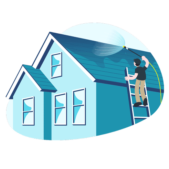
Soft washing is the right approach. It uses low pressure and a treatment solution that kills the algae at the biological level, then lets rain rinse the rest away over the following weeks. No granule damage, no blasted shingles. It is the method that is actually compatible with the roof you are trying to protect.
The same logic scales to other materials. Tile, metal, slate, and wood all stain too, and every one of them wants a gentle, material-appropriate approach instead of brute force. Slate and old tile are brittle. Metal has a coating you do not want to scrub off. Wood soaks up whatever you throw at it. When in doubt, gentle wins.
How to Actually Keep It Off
You cannot stop spores from landing. What you can do is make your roof a lousy place for them to grow. Every one of these comes back to the same goal, which is helping your roof dry out faster.
- Trim back overhanging branches for more sun and more airflow.
- Keep the gutters and valleys clear, because standing debris means standing water.
- Open up the airflow around the roofline where you reasonably can.
- Keep an eye on the shady north side. That is your early-warning zone.
- Fix drainage that lets water pool. Moving water dries. Trapped water grows things.
If your shingles are due for replacement anyway, algae-resistant ones with copper or zinc granules are worth it. They do not make you immune, but they slow the whole process down a lot.
When to Call a Pro
Routine eyeballing catches most problems early. But it is worth bringing someone in when the streaking covers a big chunk of the roof, when it keeps coming back no matter what you do, when the roof is steep or hard to get on safely, or when you have a delicate material like slate or aging tile that needs a careful hand. A good pro also matches the cleaning method to your specific roof and helps you spot the conditions that keep inviting the algae back.
The Bottom Line
Black algae on a Florida roof is not a sign that something is broken. It is a predictable reaction to humidity, shade, moisture, and spores that are simply part of the environment here. You are never going to make your roof spore-proof.
But you can absolutely make it a hard place for algae to live. Figure out where your roof lands on the FRARI check, get it soft washed instead of blasted, and spend your energy on the one thing that actually matters, which is helping it dry out faster. Do that, and you will spend a lot less time and money chasing the same black streaks year after year.




FOLLOW US
Business Hours
Monday- Saturday
9am-5pm