
Restoring a Lakefront Pool Area Before a Family Party
A screened enclosure and painted deck that hadn't been cleaned in years — with mold, algae, spider webs and orange irrigation staining. Here's how Baha Softwash restored it in time for a grandchild's party, using the right treatment for each surface.
Project Overview
Years of Buildup Around a Lakefront Pool
This St. Cloud homeowner had an important reason for finally getting their pool area professionally cleaned: their grandchild's party was coming up. The lakefront property had a screened enclosure and concrete deck that hadn't received a thorough cleaning in years. By the time they found Baha Softwash on Google, algae, mold, spider webs, insects and other organic buildup had accumulated throughout the enclosure.
The home's lakefront location added another challenge. Being close to the water means the pool area is exposed to plenty of insect activity, and protected corners of a screen enclosure provide ideal places for spiders to establish webs and for bugs and debris to gather. But once we inspected the property, we discovered another problem — the painted pool deck had begun deteriorating in areas and was covered by a light layer of orange irrigation staining.
Several contaminants, several surfaces. This wasn't one type of dirt that could be blasted away — each problem needed to be treated appropriately, and that changed how we approached the entire project.
The Challenge: Cleaning Without Damaging the Cage or Deck
Pool enclosures can look incredibly durable — but that doesn't mean they should be pressure washed aggressively. Florida pool cages commonly use coated or anodized aluminum framing combined with fiberglass screening. Over time, the frame's finish can oxidize, while screens and their attachment points become more vulnerable to damage.
Before cleaning anything, we inspected the enclosure for loose, damaged or compromised screens — because discovering a damaged screen before cleaning is very different from discovering one after the job begins. We also inspected the painted deck. Because portions of the coating were already deteriorating, we knew high pressure wasn't worth the risk.
Our objective: remove years of organic buildup and staining while using the least aggressive process necessary for the existing condition of the surfaces.
Why We Chose Soft Washing
Soft washing gave us much more control than trying to clean the enclosure with water pressure alone. Spider webs are a great example — they adhere extremely well to screens, aluminum framing and corners, and simply hitting them with more pressure isn't necessarily effective while raising the risk of damaging the screen or finish. Instead, we applied a cleaning solution designed to loosen and treat:
- Green algae
- Mold and mildew
- Spider webs
- Organic buildup
- Insect debris
- Surface grime
We treated both the inside and outside of the pool enclosure, along with the deck. The solution does the bulk of the cleaning work; water is then used at controlled pressure to rinse the loosened material away.
Preparing the Pool Area for Cleaning
Before applying our cleaning solution, we pre-wet the surfaces throughout the work area — particularly important with aging painted surfaces and metal framing — and saturated the surrounding vegetation with water. Our preparation included:
Inspecting the screen enclosure for existing damage or loose screens
Evaluating the condition of the painted deck
Identifying the irrigation staining
Pre-wetting the enclosure and deck
Saturating nearby landscaping
Preparing the interior and exterior for treatment
Cleaning the Inside and Outside of the Screen Enclosure
We applied our soft-washing solution across both sides of the enclosure and the pool deck. Rather than immediately rinsing it away, we allowed roughly 5–10 minutes of dwell time while monitoring the surfaces and keeping appropriate areas wet. That dwell time gave the treatment an opportunity to loosen the mold, algae, webs and other organic material.
We then performed a controlled low-pressure rinse, working across the enclosure and deck until the loosened buildup had been removed. That's when the next problem became much more obvious.
Removing the Orange Irrigation Stains From the Deck
Once the organic buildup was gone, the orange irrigation staining across the deck became clearly visible — and that's an important distinction. Organic growth and irrigation rust are different problems. A treatment designed to remove algae and mildew isn't necessarily the right treatment for iron staining.
Rather than trying to remove the remaining orange discoloration with more pressure, we applied a separate iron-removal treatment to the affected portions of the deck. Because the existing paint was already showing signs of failure, we approached the treatment carefully and avoided unnecessary mechanical force. After treating the staining, we performed another thorough rinse — leaving a dramatically cleaner, brighter pool area without unnecessarily attacking the aging deck coating.
What About Cleaning Solution Getting Into the Pool?
This is one of the most common questions homeowners ask during pool enclosure cleaning. The important part is proper application, dilution and rinsing. Pool water already relies on chlorine chemistry for sanitation, but that doesn't mean concentrated exterior-cleaning chemicals should simply be dumped into a swimming pool. We control application around the pool, minimize unnecessary runoff, and thoroughly rinse the work area.
With the cleaning completed and the pool returned to normal operating conditions, the homeowner could get back to using the area without waiting days for the exterior cleaning to clear.
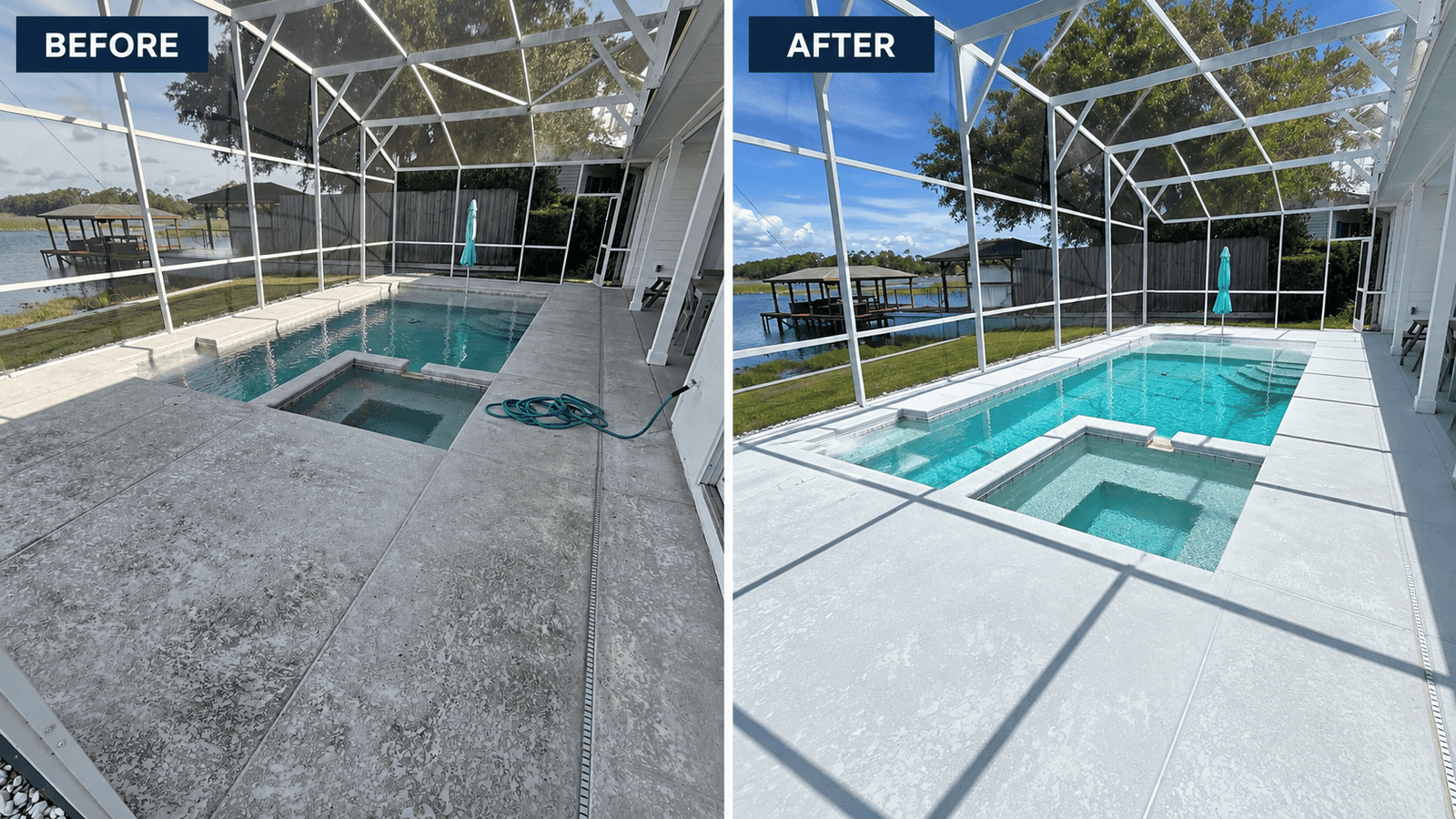
A Completely Different Backyard
The transformation wasn't limited to one surface. The screen enclosure looked cleaner and brighter, with years of organic buildup, spider webs and insect debris removed from the framing and screening. The deck lost the dirty, weathered appearance created by the combination of organic buildup and orange irrigation staining. With everything cleaned together, the entire pool area felt noticeably different — and with the grandchild's party approaching, the backyard once again felt ready to entertain. The homeowner was amazed with the transformation and extremely happy with the final result.
Why This Lakefront Pool Area Needs Recurring Maintenance
Cleaning solved the immediate problem, but it doesn't change the environment surrounding this St. Cloud home — it's still a lakefront property. That means insects, spiders, moisture and organic debris will continue interacting with the enclosure.
Rather than waiting another several years for the pool cage to reach the same condition, we discussed ongoing maintenance with the homeowner and scheduled recurring cleaning. Regular maintenance should make each future cleaning considerably easier, while keeping the pool area consistently ready to use.
What This Pool Enclosure Cleaning Demonstrates
This job is a great example of why we don't treat every dirty surface with the same equipment or process. Knowing the difference between these problems is what lets us clean effectively without trying to solve everything by simply increasing pressure:
Need Your Pool Enclosure Cleaned in St. Cloud?
If your pool cage, screens or deck are developing algae, mold, mildew, spider webs, insect buildup or irrigation staining, Baha Softwash can evaluate the surfaces and determine the right process — protecting the screens, framing, deck and surrounding property.